I don’t really agree with his line of analysis, but just saw that the introduction of the late Robert S Wistrich’s important From Ambivalence to Betrayal: The Left, the Jews, and Israel is online [PDF] on the University of Nebraska Press website.
Filed under: Fascism and antisemitism | Leave a Comment
Tags: Robert S Wistrich
Photos of the “Berlin against Hamas” counterdemonstration here.
Filed under: germany, Israel/Palestine, Uncategorized | Leave a Comment
Tags: Benjamin Weinthal, Berlin Against Hamas, Hamas
Rock ‘n’ roll Nazi chic
10Apr15

Filed under: music | 1 Comment
Tags: MC5, Nazi chic, New Order, punk rock, Ron Asheton, Stooges
Against vulgar anti-imperialism
06Aug14
A long critique by Andrew Coates of Andrew Murray’s “anti-imperialism”. You should read it, but here’s an extract:
One wonder how many other ‘challengers’ to US hegemony also “mandate” contingent support? To be supported (or in real terms, given kind words and some public show of endorsement) how far can a foreign policy trump a domestic one? A debate has begun on the US-left, with echoes in Europe, on Hamas. The American International Socialist Organization reject any backing for the violent, reactionary ISIS and Islamic State Islamists in Syria and Iraq. But they offer “unconditional but critical” support for the Gaza wing of the Muslim Brotherhood which has right-wing anti-socialist and anti-liberal policies. (3) The importance of their anti-imperialist battle with Israel over-rides their anti-democratic and corrupt practices.
Others might argue that it would be better simply to oppose Israel’s actions in attacking the Palestinians and depriving them of their rights than in to offer any succour to a group with a proven record of hostility to any form of left-wing and progressive politics. No amount of bluster about solidarity can disguise this side of Hamas. Israel’s actions need to be fought by a coherent movement, one not entangled in this dead-end. Such a push requires co-operation with Israeli citizens opposed to their state’s policies, and not a call to drive them into the sea. This is not to “blame” Hamas, it is simply not to take their political side.
Romantic third-worldism appears to have survived the collapse of any specific “non-capitalist” development after the fall of Official Communism and the rise of neo-liberal economics and politics. Perhaps we are seeing signs of a part others about to plunge into a second-youth, digging out dusty copies of Frantz Fanon to find inspiration for their “anti-imperialism”. (4) It continued to exist in the half-life of university “post-colonial” theory and some marginal groupuscules, like the French Les Indigènes de la République. These self-appointed representatives of the “natives” battle against neo-colonialist secularism and Marxism. They really are unconditional backers of Hamas, and treat the racist anti-Semite, ‘anti-Zionist’, and Holocaust denier, Dieudonné with great tenderness.
Filed under: the poverty of anti-imperialism | 1 Comment
Tags: Andrew Murray, Anti-imperialism
This is from the brilliant blog Mystical Politics:
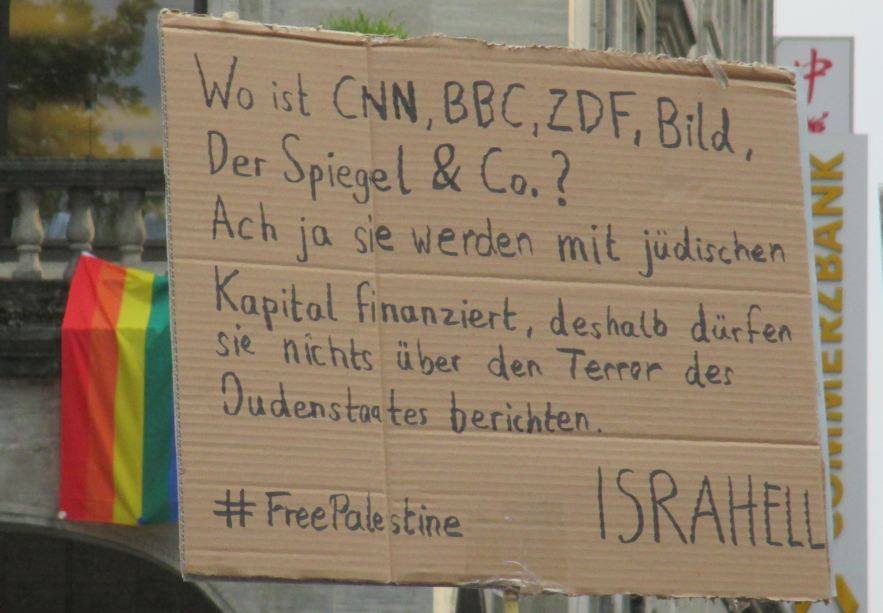
More antisemitism at rallies against the Gaza war. This photo is from a rally in Stuttart, Germany, on July 25, 2014.
Source: http://emafrie.de/category/texte-von-emafrie. The poster in the center has an image on it by the French artist Zeon.Here are a couple more photos of the same demonstration:Translation: “Where are CNN, BBC, ZDF, Bild, Spiegel, and Co.? They are financed by Jewish capital, therefore they do not report about the terror of the Jewish State.”Both of these posters are from Zeon, who seems to specialize in antisemitic and anti-Israel images. See here for a close-up of the image on the right-hand poster.



See also:
Antisemitism in anti-Israel rally in Sydney, Australia
Wave of anti-Semitic rallies hits cities across Germany
Anti-Israel demonstration in Zurich, Switzerland, July 18, 2014
Racist demonstration in Jerusalem on July 14
Filed under: germany, the anti-Zionism of idiots | Leave a Comment
Tags: #GazaUnderAttack, #GazaUnderFire, Gaza, Stuttgart, Zeon
This is by Reem Abu-Hayyeh at the excellent IRR news service. Read the original here.
A timely pamphlet aimed primarily at French trades unionists provides an opportunity to reflect on the FN’s growing appeal to working-class voters.
‘If we don’t stop the waves of immigration, in ten years whites will become a minority in France.’
‘If we had real freedom of expression we would be able to say anything, including racist remarks.’
‘Foreign workers from poor countries are ready to work for any kind of salary and under any conditions; it is because of them that there has been a social recession.’
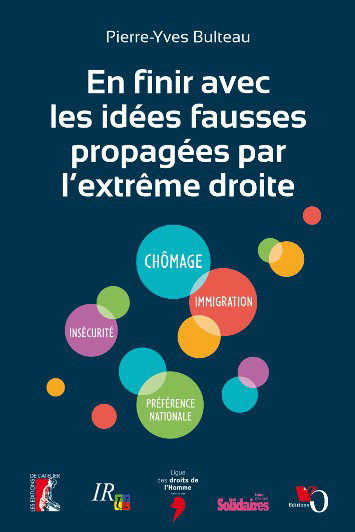
It is myths such as these that journalist Pierre-Yves Bulteau, with the financial support and research assistance of charities, trade unions and organisations,[1] attempts to debunk in the (French-language) pamphlet, En finir avec les idées fausses propagées par l’extrême droite (‘Putting an end to the myths spread by the extreme Right’). In this attractively produced, simply written and accessible 160-page pamphlet (perhaps, more aptly described as a small book), Bulteau takes 73 popular myths propagated by the far Right and breaks them down into the generic themes of: ‘The foreigners are guilty’; ‘It’s the system’s fault’; ‘France for the French’ and ‘False solutions’.
The author sets out with a purpose, to provide: ‘a weapon to arm the members of our organisations who ask us how to respond.’ This timely intervention came shortly after the French local elections in which the Front National (FN) captured 1,546 municipality seats and gained control of ten towns across France, and on the eve of the European elections where a quarter of French voters cast their vote for the FN. Amongst FN gains was the previously Parti Socialiste (PS) stronghold of Hénin-Beaumont. A mayor who ran on the FN ticket is Robert Ménard, a founder of Reporters Without Borders and former activist with the Revolutionary Communist League[2]. Similarly, Fabien Engelmann, the new mayor of Hayange (once famous for its iron mines) was formerly active in the Trotskyist party, Lutte Ouvrière (Workers’ Struggle) and the Nouveau Parti Anticapitaliste (New Anticapitalist Party), which he broke with when it fielded a veiled Muslim woman candidate in a regional election. His former trade union, the CGT, attempted to expel him when his affiliation to the FN became known.
Continue reading ‘French Front National: fake anti-globalization rhetoric’
Filed under: Fascists in the anti-globalization movement, France | Leave a Comment
Tags: Fabien Engelmann, Front National, Marine Le, Pierre-Yves Bulteau, Robert Ménard, Thierry Gourlot
Anti-Zionist antisemites
15Jul14
Of course anti-Zionism is not the same as antisemitism. But some anti-Zionists are antisemites. Here’s three examples.
1. Parisian anti-Israel protestors besiege Jews in synagogues.
At the weekend, it is reported that “three Paris synagogues sustained anti-Semitic attacks over the weekend with rioters sending three Jews to the hospital.” Note well: not the Israeli embassy, but Jewish synagogues.
In the 11th arrondissement in eastern Paris, breakaway anti-Israel marchers “tried to force their way into a Paris synagogue Sunday with bats and chairs, then fought with security officers who blocked their way, according to police and a witness.”
A police spokeswoman said the Don Isaac Abravanel synagogue in eastern Paris was targeted during a service, and worshippers were blocked inside while police pushed protesters back. The spokeswoman said all those inside left safely by Sunday evening.
Aline Le Bail-Kremer watched the incident unfold from her window across the street. She said protesters came from two directions and converged on the synagogue, grabbing chairs from sidewalk cafes and wielding bats as they tried to push past security guards.
Another synagogue on Rue de la Roquette in Paris was attacked by rioters hurling stones, according to the Times of Israel. Earlier on Saturday, rioters hurled a Molotov cocktail at a synagogue in Aulnay-sous-Bois, a suburb of Paris.
On the march itself, “Among the protesters were those who carried signs reading “Gaza is a concentration camp” and “Anti-Zionism,” according to local reports, and some called out “Death to Jews.””
One French Green Party politician defended the antisemitic attacks. Pierre Minnaert said it was “not surprising” that synagogues “under attack” when they support Israel’s policies.

Protestors doing antisemitic quenelle saluate. Via @mendelpol


2. Meanwhile in Frankfurt, Germany:
Eight police officers were injured. One sign at the rally was titled, “You Jews are Beasts.”
German media reported that after the protests, groups sought to locate Jewish institutions. The Frankfurt police said Jewish institutions would be protected. It is unclear if the goal was to attack said institutions.
According to the Rundschau, student organization Left-SDS, Islamists and some members of the Neo-Nazi group National Socialists Rhein-Main attended the anti-Israel protest. Flags from Turkey, Iraq, Saudi Arabia and Hamas were on display at the protest. Banners compared Prime Minister Netanyahu with Adolf Hitler. Supporters of Assad’s regime were also present at the protest.
In a bizarre act of cooperation, German journalist and publicist Thomas von der Osten-Sacken reported on the website of the weekly Jungle World that Frankfurt’s police allowed the demonstrators to use a police vehicle and loudspeaker to blast anti-Israeli slogans. According to a police statement, the authorities allowed the use of their equipment in order to deescalate the situation. The Jungle World article sarcastically titled its account, “The Police, Friend and Helper.”

Spontaner Protest auf der Zeil. Foto: Rolf Oeser. Via Frankfurter Rundschau.
3. #HitlerWasRight
Meanwhile, the hashtag #HitlerWasRight has been trending on social media, showing the extent to which Holocaust denial and Nazi ideology have permeated the anti-Zionist movement. Read more about this here.
Filed under: Fascism and antisemitism, France, germany, the anti-Zionism of idiots | 3 Comments
Tags: #GazaUnderAttack, #GazaUnderFire, #HitlerWasRight, Operation Protective Edge, Pierre Minnaert
Left/right convergence in France
28Jun14
Several items from Tendance Coatesy, on the Voltaire Network, on the French far right’s links to Putinism, and on Godard’s fascist turn.
1. On Franklin Lamb and France’s Assad supporters:
Counterpunch has published some well-informed reports on the unfolding civil war in Iraq, notably by Patrick Cockburn. The same cannot be said for the latest piece by the notorious Franklin Lamb, who has been linked to the far-right Réseau Voltaire (Voltaire Network) (23 articles, up to 2001)… [In his article on ISIS, the] Reseau Voltaire contributor [i.e. Lamb] records this comment,
ISIS appears uniformly contemptuous of the Zionist regime and its army and also appears eager to fight them in the near future despite expectation that the regime will use nuclear weapons. “Do you think that we do not have access to nuclear devices? The Zionists know that we do and if we ever believe they are about to use theirs we will not hesitate. After the Zionists are gone, Palestine will have to be decontaminated and rebuilt just like areas where there has been radiation released.”…
One feels deep disgust at anybody relishing the kind of ‘liberation’ ISIS would bring to Israel. Coatesy has background on the Voltaire Network: see here on Thierry Meyssan, here on their Syria conspiracy theories, but in particular here: After Israel Shamir, we have Franklin P.Lamb. He is a regular on the fascist ‘anti-imperialist’ Voltaire Network (23 articles – here). His latest Counterpunch offering is an ‘analysis’ which claims that the Syrian uprising is being used to undermine the ‘resistance’ force Hezbollah, “Implementing the Feltman Project. Is the Syrian Crisis Being Leveraged to Weaken Hezbollah?” One expects the answer, given the premis that Hezbollah is the “leader of the international Resistance.” He concludes by asking, The coming weeks will reveal what, if any, success foreign and domestic anti-Resistance forces achieve in using the Syrian crisis to dismantle Hezbollah. This is a curious way of putting things, until you realise where Lamb’s thought processes originate. […]
What is Lamb’s Voltaire Network? The President of the Network of Thierry Meyssan, 9/11 The Big Lie, which claimed that the 11th of September 2001 was due to an internal plot within the US administration. The Network broadcast this declaration widely. Meyssan’s works appear regularly on the Holocaust deniers’ site, Entre la plume et l’enclume. The Voltaire Network is better known under its French title, Réseau Voltaire. It has faced accusations of supporting the Chinese and Russian states, anti-Semitism, and alignment with Islamists. Supporters who resigned in 2005 said, …Under the pretext of resistance to American imperialism arrangements have been made with Russian and Chinese imperialisms, and their alignment with Islamists has led to a drift towards anti-semitism, latent amongst its leading figures. Thierry Meyssan is closely associated with the fascist and racist Dieudonné and his ‘anti-Zionist’ Party (Parti Anti Sioniste). There is not formal tie between the Réseau Voltaire and this, very marginal, political party. But what is clear is that the Voltaire Network is pro-Assad, like the Parti Anti Sioniste as are many from this ‘nébuleuse‘. […]
With yet another contributor to Counterpunch from this background we wonder why anybody takes it seriously, or indeed, took Alexander Cockburn seriously at all – ever.

This appeared in Le Monde [early in June]:
Moscow-Paris-Vienna : the meetings and acquaintances of Aymeric Chauprade, Adviser of Marine Le Pen Le Monde. (Adapted Extracts)
The Eurodeputy for the Front National – Rassemblement Bleu Marine (RBM), –Aymeric Chauprade (wikipedia – in English), took part in strange meeting on Saturday the 31st of May in Vienna. (Austria) The meeting was called under the title of the 200 years of the Holy Alliance, which brought together Imperial Russia, the Austrian Empire, and the Prussian kingdom. The event was organised by the the Russian oligarch Konstantin Malofeev, who is linked to Ukrainian separatists in Donetsk in the Ukraine. According to the Swiss newspaper Tages Anzeiger, this get-together was held to discuss how to save Europe from liberalism (economic and political) and the “homosexual lobby”. Those present included Heinz-Christian Strache, leader of the far-right Austrian FPÖ (allies of Marine Le Pen), and Volen Siderov of the Bulgarian extreme-right party Ataka (with whom Le Pen refuses to work).
The most striking guest was Aleksandr Gelyevich Dugin Putin’s éminence grise and Eurasian ideologue. (1) M. Chauprade has already worked with the most radical wing of the Pro- Putin forces. During the Crimean referendum in Crimea he was an observer for a NGO linked to Eurasian ideas, the Eurasian Observatory for Democracy and Elections (EODE) (2). This body is led by Luc Michel, European National Communitarian Party (ENCP) (3), a red-brown groupuscule that continues the work of the neo-fascist Jean Thiriart. The EODE observers came from diverse quarters, from the Greek Communist Party (KKE) Die Linke, Forza italia (qui the Flemish far-right, Vlaams Belaang and Enrique Ravello of Plataforma per Catalunya. The latter had been a member of the Cedade, a grouping of Spanish neo-Nazis.
References from Wikipedia.
(1) Aleksandr Gelyevich Dugin (Russian: Алекса́ндр Ге́льевич Ду́гин, born 7 January 1962) is a Russian political scientist, traditionalist, and one of the most popular ideologists of the creation of a Eurasian empire that would be against the “North Atlantic interests”. He is known for his fascist views,[1][2][3][4] and had close ties to the Kremlin and Russian military.[5] Dugin serves as an adviser to State Duma speaker (and key member of the ruling United Russia party) Sergei Naryshkin.[6]
(2) Eurasian Observatory for Democracy and Elections (EODE) is a Russia-based far-rightnon-governmental organization which on its website claims that it monitors elections.[1][2] According to its website, it specializes in the “self-proclaimed republics” (Abkhazia, Transdnistria, Nagorno-Karabakh).[3][1] It is led by the Belgian far-right activist Luc Michel.[4] EODE’s other leader is Jean-Pierre Vandersmissen. Both Michel and Vandermissen are followers of the Belgian Neo-Nazi politician Jean-François Thiriart.[5][6][7] According to Oliver Bullough, on its website the organization stated that “it shares the values of “the current Russian leadership and V.V. Putin.””[8] EODE visited Crimea during the 2014 Crimean referendum international observer team and claimed that the referendum was conducted in a legitimate manner.[9][10]
(3) The Parti communautaire national-européen (PCN) is a Belgium-based political organisation led by Luc Michel, a former member of the Neo-Nazi FANE party. A largely National Bolshevik movement, it also has activists in France.[1] The PCN was founded in 1984 as a successor to the similar Parti Communautaire Européen. The party bases its ideas on those of Jean-François Thiriart,[1] who served as an advisor to Michel for a time after the foundation of the group, and seeks the creation of a single European state stretching entity from Russia to the Atlantic coast. Including activists with origins on both the far right and far left, it seeks to liberate Europe from its ‘Yankee and Zionist enemies’.[2] Its founding membership included both those whose background was neo-fascism and former Maoists.[3] It has also been noted for giving support to controversial world leaders, most notably Iraq‘s Saddam Hussein and Libya‘s Muammar al-Gaddafi.[4] It also declared its support for ecologism.[5] According to Eric Rossi PCN belongs to a strand of the Francophone far right that he identifies as “ethno-differentialist revolutionary nationalism”, in which he also includes Nouvelle Résistance, Groupe Union Défense, Troisième voie and Groupement de recherche et d’études pour la civilisation européenne. He contrasts this with the “exclusivist nationalists” (as represented by Œuvre française) and the “supremacist racialist nationalists” (Fédération d’action nationale et européenne and Parti nationaliste français et européen), although including all three groups within a wider model of neo-fascism.[6] The party has, from time to time, contested elections in Belgium and France (without securing elected office), although at the last Belgian elections they told their supporters to vote for the Vlaams Belang.
3. On Jean-Luc Godard:

David Thompson once commented that Jean-Luc Godard, the celebrated, and once leftist, cinéaste was fated to remain a “Young Turk” all his life. Now approaching his dotage Godard still feels the need to make provocative statements. Interviewed at length in yesterday’s Le Monde and asked about the European election results he announced, J’espérais que le Front national arriverait en tête. Je trouve que Hollande devrait nommer – je l’avais dit à France Inter, mais ils l’ont supprimé – Marine Le Pen premier ministre.” I was hoping that the Front National would come first. I find that Hollande should nominate – I said this on France Inter, but they cut it out – Marine Le Pen as Prime Minister.
Asked by the newspaper the reasons why he took this stand, the film-director responded, “To shake things up, so that we make at least some moves towards changing things, even if they don’t really do so. It’s better than pretending to do nothing. Jean-Luc Godard continued his theme, recalling that, “The Front National had 2 seats on the National Resistance Council. At that time it was a pro-Communist organisation. Still, despite this it was called the Front National….”
The interviewers reminded him that this Front National had nothing to do with the present-day Front National, created in 1972 by Jean-Marie Le Pen, and that only the name was identical (a synonymy). Jean-Luc Godard did not back down, “No. If you say its the same word, you are stuck in words, not facts. It is a fact. Given the importance of this nomination, this is also a synonymy as well…the Prime Minister of Luxembourg is called Junker. That is also the name of the German bombers…. The Franco-Swiss film-maker did recognise that he was “not one of them” (the Front National). “Jean-Marie Le Pen wanted for a long time to kick me out of France..but I simply wish that things change. The real winners (of the elections) were those who abstained, and I’ve been one of them for a long time.”
Filed under: France, Left-right convergence, Middle East | 1 Comment
Tags: Aleksandr Dugin, Aleksandr Gelyevich Dugin, Ataka, Aymeric Chauprad, Counterpunch, Eurasian Observatory for Democracy and Elections, Franklin Lamb, Front National, Heinz-Christian Strache, Jean-Luc Godard, Konstantin Malofeev, Marine Le Pen, Parti Anti Sioniste, Parti communautaire national-européen, Rassemblement Bleu Marine, Réseau Voltaire, russia, Syria, Thierry Meyssan, Volen Siderov, Voltaire Network
Wawrzyn, Heidemarie: Nazis in the Holy Land 1933-1948
Co-published by The Hebrew University Magnes Press and De Gruyter for the Vidal Sassoon International Center for the Study of Antisemitism.
Young Germans marched through Haifa shouting “Heil Hitler!” and Swastika flags were hoisted at the German consulates in Mandatory Palestine. It was in November 1931 when a non-Jewish German made the initial contact with Nazi officials in Germany that led to the establishment of a miniature Third Reich with local NS groups, Hitler Youth program, and associations for women, teachers, and others in Palestine. Approximately 33% of all Palestine-Germans (Palästina-Deutsche) participated in the NS movement. Until today no extensive research written in English has been done on this bizarre “footnote” in history.
While previous publications in German mainly concentrated on the members of the Temple Society, this work includes Protestant and Catholic Germans as well. It focuses on the relationship of Palästina-Deutsche with local Arabs and Jews. It covers the period of 1933 to 1948 as well as the years between the establishing of the State of Israel and the departure of the last group of Germans in 1950. At the end of the book, the reader will find a list with more than seven hundred names of those who joined the NS groups.
Filed under: Nazis in the Middle East | Leave a Comment
Tags: Heidemarie Wawrzyn, Mandate Palestine, Nazis, Palästina-Deutsche, Palestine, Temple Society

 Anti-National Translation
